Stalemate in the Middle East
The war with the revolutionary Islamist regime in Iran – and its proxies – is at a crossroads..
Between February and April, the joint U.S.-Israel military operation in Iran significantly degraded Iran's military and nuclear capabilities. This opened a unique opportunity to topple the regime, reverse its regional dominance and achieve the war’s main goal to ensure that Iran can never acquire a nuclear weapon.
However, the U.S. Administration under President Trump backed away from further military action, agreeing a ceasefire and entering into discussions with the Iranian regime. All the while the IRGC has been able to consolidate control in Iran and continues to keep the Strait of Hormuz closed.
With mid-term elections in sight, Trump is under increasing domestic pressure to end the war with Iran.
It is difficult to know exactly how the U.S.-Iran talks are proceeding. Each side sends divergent messages. Tehran insists on steep conditions for progress, even as US President Donald Trump again voiced optimism, telling reporters on Wednesday that a deal “could happen” over the weekend. On Thursday, according to a report on Channel 12, the US sent a message to Pakistan, which is acting as a mediator, demanding a reply from Iran by the weekend and a signing ceremony in Geneva next week. It was unclear what the consequences would be if Iran failed to abide by those terms.
It seems the U.S. has been out-negotiated. The IRGC has the upper hand. Analyst Eric Mandel writes:
- “Most troubling is the Strait of Hormuz. After the closure of the Strait crossed a long-standing American red line, Operation Freedom was abandoned in favor of a U.S.-Iran ceasefire that promised the immediate reopening of the international waterway. Nearly two months later, Iran continues to target vessels in the Strait of Hormuz, threatening American allies from Kuwait to the UAE and Bahrain, and refusing to fully reopen international waterways or make the concessions needed to demonstrate an end to its nuclear weapons ambitions.”
The IRGC appears convinced it can outlast and outweigh U.S. pressure. This is before even considering Iran’s ballistic missile program and continued support for regional proxies.
The International Atomic Energy Agency, meanwhile, said in a confidential report that a lack of access to verify nuclear material in Iran posed a “proliferation concern,” calling on the Islamic Republic to “engage the agency constructively.”
Lebanon
In Lebanon, the U.S. administration has largely accepted Iranian demands by restraining Israeli operations against Hezbollah in its southern Beirut stronghold, while placing hope in Lebanese-Israeli diplomatic talks at the ambassadorial level. According to Mandel, “restraining Israel's offensive operations in Lebanon transformed a strategic and negotiating advantage into an unnecessary concession, providing Iran and Hezbollah valuable breathing room.”
As long as Hezbollah remains Lebanon’s dominant force and is deeply embedded within the Lebanese state and security apparatus, any agreement between Israel and Lebanon is unlikely.
This week, an IDF officer was killed in a Hezbollah anti-tank guided missile attack in southern Lebanon on Thursday.
Hezbollah Secretary-General Naim Qassem on Thursday rejected a U.S.-brokered ceasefire between Israel and Lebanon, warning that the Iran-backed terrorist group would continue attacking as long as Israeli operations persist.
- “We have not given anyone a commitment not to resist aggression and respond to it,” Qassem said in remarks carried by Hezbollah-affiliated Al Manar, adding that “as long as the aggression continues, we will confront it with all the strength we possess.”
Qassem said any ceasefire must include a full halt to Israeli military activity across Lebanon and a withdrawal of Israeli forces, alongside the return of displaced residents and reconstruction efforts. He described Lebanese sovereignty as the “primary objective,” calling for “halting Israeli aggression in all its forms—air, land and sea,” and deploying the Lebanese army south of the Litani River, according to Al Manar.
He also denounced U.S.-led diplomacy and any efforts to disarm Hezbollah, calling direct negotiations a “farce” and the so-called Washington Declaration “a roadmap for the extermination of a segment of the Lebanese people.”
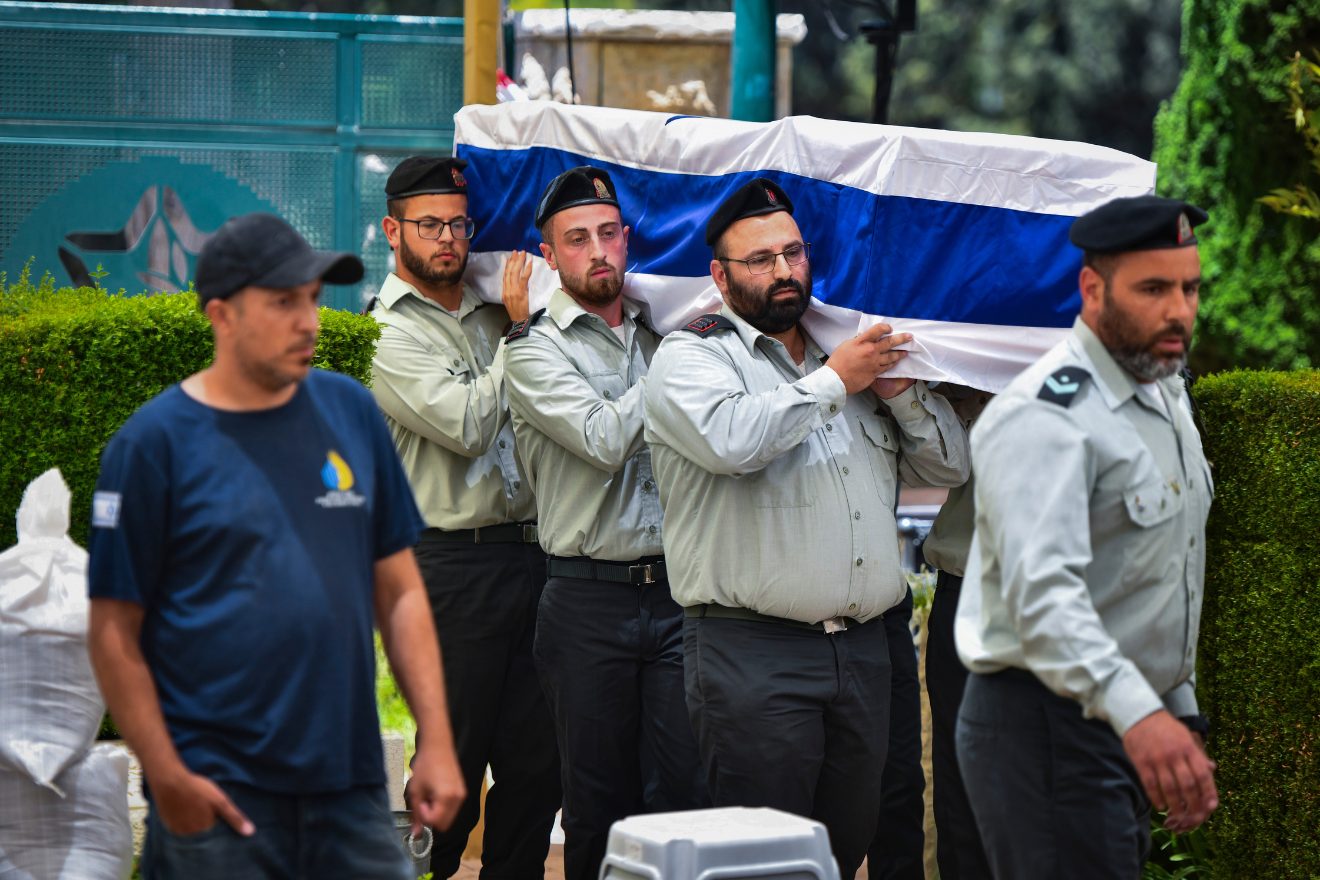
Family and friends of Israeli soldier Captain Eitan Shmuel Lemberg attend his funeral at the Military Cemetery in Rishon LeZion | Photo: Avshalom Sassoni/Flash90
Gaza
In Gaza, this week the Israeli Air Force and Israeli Navy carried out strikes killing top commanders in Hamas’s general security mechanism. According to health officials in Gaza, at least nine Palestinians were killed in strikes on four apartments early on Thursday. Hassan Labad, the deputy head of the security mechanism, along with senior officials Asem Shabir, Abdullah Abu Kaloub, and Mohammed Abu Marek, were killed in the strikes, the Israel Defense Forces said.
Hamas remains in control of the Palestinian-held territory in the Strip. While Hamas only controls about 40% of the Strip, it has used the ceasefire of the past months to re-arm, re-equip and re-assert its dominance. Like Hezbollah, Hamas also refuses to disarm or to disavow its intentions to attack Israel. The Board of Peace created under the Trump peace plan for Gaza that was endorsed by the UN Security Council has so far completely failed to achieve any progress in ensuring the demilitarization of Gaza and its reconstruction.
In short: the Middle East is in a stalemate.
This week, let us pray for the people of Israel, and for their leaders.
Pray for the enemies of the Jewish people.
Above all, let us continue to look to God and trust that He will fulfill His promises. Pray for the peace of Jerusalem, and the speedy coming of the Messiah of Abraham, Isaac and Jacob. He alone can protect His people, and usher in a kingdom of peace and righteousness.

Renewing military strikes against Iran is the only way to end its nuclear ambitions
Con Coughlin at Gatestone: “In the seemingly endless to and fro over the Trump administration's attempts to negotiate a peace deal with Tehran, the one red line upon which there can be no hint of compromise is US President Donald J. Trump's insistence that the ayatollahs will never be allowed to acquire nuclear weapons. While speculation continues to mount that a deal to end the three-month conflict between Iran and the US is in the offing, it is clear that Iran is still resisting demands that it surrender the estimated 970 pounds of enriched uranium — whose main utility is for the production of nuclear warheads.”
What Happens When Jihadists Smell Weakness
Khaled Abu Toameh at Gatestone: “Iran has been dictating to Washington when and with whom it will negotiate. Washington apparently never insisted upon face-to-face negotiations with Iran. Why not? By discontinuing talks with the US, Iran also succeeded in maneuvering the Trump Administration into two huge victories for the current regime.”
Iran's Mafia State Understands Only Law Backed by Power
Ahmed Charai at Gatestone: “Iran is not a normal state pursuing normal interests. It is a mafia state hiding its aggression behind ideology, proxies, negotiations, and delay. It respects neither international law nor the sovereignty of its neighbors — not even the Gulf states that tried to preserve "mediation" channels.”
What is decisive victory?
Ohad Tal at JNS: Israel must not abandon the decisive stage of this war in exchange for temporary quiet. Deterrence alone is insufficient. Lasting security requires strategic depth, freedom of military action and permanent control of key buffer zones separating Israeli communities from hostile forces.
SCRIPTURE FOR THE WEEK:
Jeremiah 16:14-2114 "However, the days are coming," declares the Lord , "when men will no longer say, 'As surely as the LORD lives, who brought the Israelites up out of Egypt,' 15 but they will say, 'As surely as the Lord lives, who brought the Israelites up out of the land of the north and out of all the countries where he had banished them.' For I will restore them to the land I gave their forefathers. 16 "But now I will send for many fishermen," declares the LORD , "and they will catch them. After that I will send for many hunters, and they will hunt them down on every mountain and hill and from the crevices of the rocks. 17 My eyes are on all their ways; they are not hidden from me, nor is their sin concealed from my eyes. 18 I will repay them double for their wickedness and their sin, because they have defiled my land with the lifeless forms of their vile images and have filled my inheritance with their detestable idols." 19 O LORD , my strength and my fortress, my refuge in time of distress, to you the nations will come from the ends of the earth and say, "Our fathers possessed nothing but false gods, worthless idols that did them no good. 20 Do men make their own gods? Yes, but they are not gods!" 21 "Therefore I will teach them- this time I will teach them my power and might. Then they will know that my name is the LORD.