‘Peace, peace,’ they say, when there is no peace
President Trump hailed this week’s fragile ceasefire agreement with Iran as the beginning of peace. But peace seems as far away as ever. More and more, it is becoming apparent that the conflict with Iran is a long-term war against a revolutionary Islamist ideology that is deeply embedded in Iranian society, and cannot easily be defeated. Moreover, while it is headquartered in Iran, this ideology has a deeply intertwined network of allies and proxies across the world comprising states and non-state actors. It is becoming a truly global conflict.
In a remarkable and unexpected development, tomorrow, representatives of the US and the Islamic Republic of Iran will meet in Islamabad, at the invitation of Pakistan, to discuss terms for ending the current conflict, that will have long-terms implications for the Jewish State of Israel.
Islamabad means “city” or “home of Islam.” It is therefore the home of “submission” to Allah. Yesterday, a key mediator for Pakistan, Defense Minister Khawaja Muhammad Asif, described Israel as a “malignant tumor and a curse on humanity.” He wrote on Twitter: “I hope that those who created this cancerous state on Palestinian land, to get rid of their own European Jews, will burn in hell.”
Pakistan has thus positioned itself as a mediator using the same rhetoric as Iran: the destruction of the Jewish State, the “cutting out of the cancerous tumor.” It is similar to the propaganda used 90 years ago in Nazi Germany, which infected all nations. Trump backs off – at request of Pakistan.
Having warned that the “entire civilization” of Iran would be destroyed if the regime in Iran did not agree to his demands that the Strait of Hormuz be opened, U.S. President Donald Trump agreed on Tuesday, at the last minute, to back off.
Having received an offer by Pakistan to act as intermediary, Trump announced a two-week window for negotiation of a possible long-term ceasefire.
But the exact terms of the ceasefire are contested, The US insists that its agreement to pauze hostilities is subject to Iran immediately opening the Strait of Hormuz and stopping all attacks on the United States, Israel and countries in the region.
The US and Iran are light-years apart in terms of their long-term demands. For example, the US insists that Iran be prevented from enriching uranium, while Pakistani mediators have conveyed that Iran insists on retaining the right to continue enriching uranium.
The truce is already shaky. Iran immediately claimed that the US and Israel were breaching the agreement.
The Strait of Hormuz
The Strait of Hormuz is proving to be the core physical and ideological bottlenecks. Iran’s closure of the Strait is having massive economic consequences. Oil prices have spiked, and there are huge downstream costs across the globe.
Iran threatens to charge fees for ships that wish to pass through the Strait. On Thursday Trump denounced Iran for “doing a very poor job, dishonorable some would say, of allowing Oil to go through the Strait of Hormuz. That is not the agreement we have!” Trump posted on Truth Social.
Russia
Russia is benefitting massively from the conflict with Iran. It is reported that Russia is earning an extra $150 million per day in oil revenue because of the war. The Guardian reported Russia earned $8 billion in fossil fuel revenue in the first two weeks of the conflict, and is pouring its oil profits into financing the Ukraine war. Last week, Russia (and China) vetoed a UN Security Council resolution that would have compelled Iran to reopen the Strait of Hormuz.
The future of NATO
As a result, the future of NATO is uncertain. The Europeans continue to insist that the US contribute to the massive costs of assisting Ukraine’s defense against Russia. Trump is furious at the lack of European support for his efforts against Iran.
Trump conveyed his frustration in his meeting with NATO Secretary General Mark Rutte, pressing for immediate commitments from European members to assist in ensuring free passage in the Strait of Hormuz.
Trump’s stance underscores a broader dissatisfaction that has defined his relationship with NATO for years. In a strongly worded message posted on his Truth Social platform on April 9, the president declared: “NATO WASN’T THERE WHEN WE NEEDED THEM, AND THEY WON’T BE THERE IF WE NEED THEM AGAIN.”
During this conflict with Iran, some European countries such as Spain have refused to allow American aircraft to use their bases, while others, including Germany and the United Kingdom, have avoided taking a firm stance. Their position, often summarized as “this is not our war,” highlights a widening divergence in threat perception between Washington and European capitals.
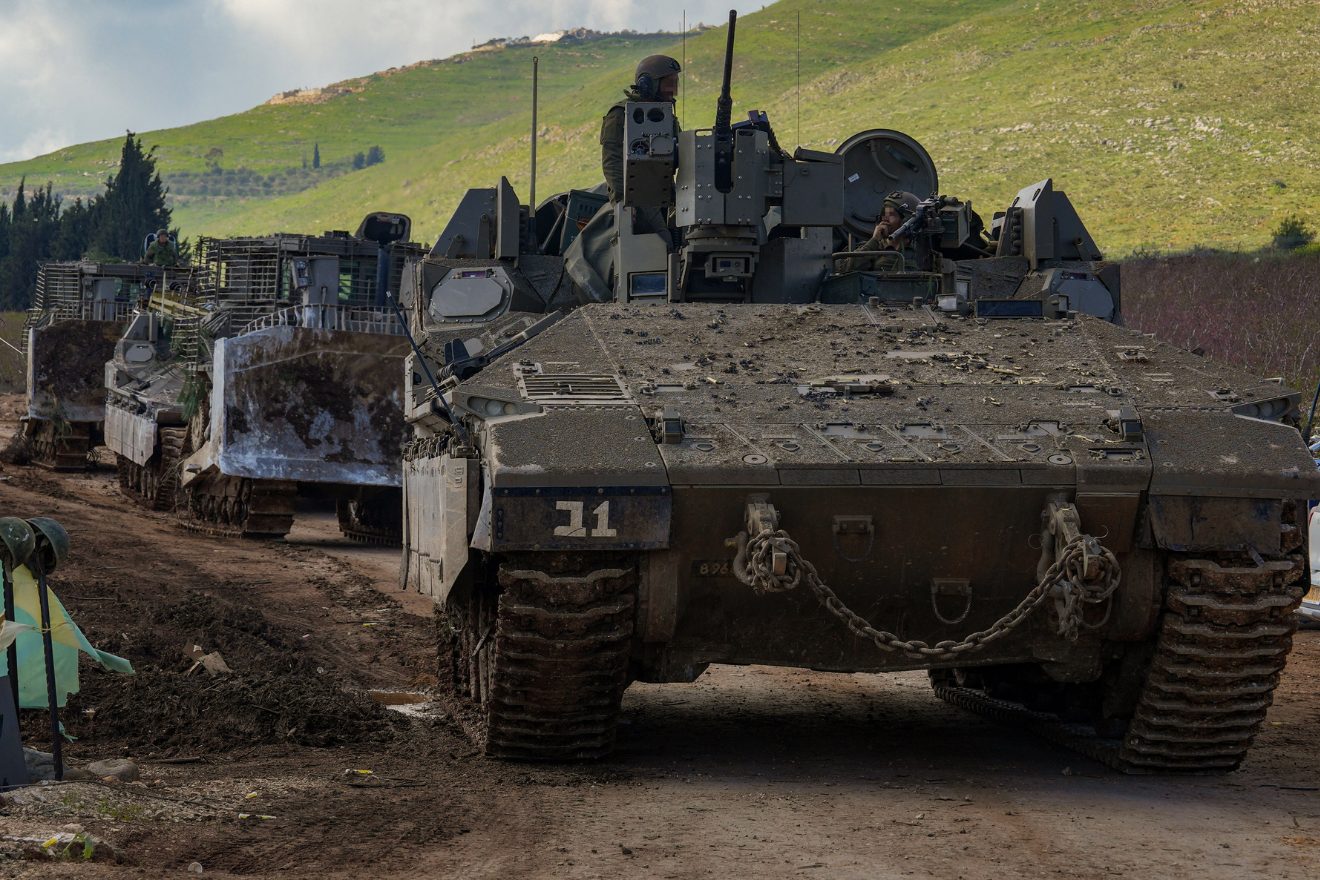
Israeli Military Vehicles Are Seen Along The Israeli Border With Lebanon| Photo: Ayal Margolin Flash90
Lebanon
The question of Iran’s proxies remains contested. From Tehran’s perspective, an Israeli halt to operations against its principal proxy Hezbollah in Lebanon is part of the price of any long-term arrangement. Israel said it had no intention of accepting such terms. In fact, in the past days, Israel ramped up its massive attacks on Hezbollah targets in Lebanon. On Thursday, Israel completed its largest coordinated strike so far in March, targeting more than 100 Hezbollah command centers and military sites in Beqaa, Beirut and southern Lebanon. Israel continues to insist that it will occupy southern Lebanon as a buffer zone up to the Litani River.
The situation in Lebanon is complex. As long as Hezbollah exists, Israel faces a dilemma, described by analyst Mitchell bard as follows:
- “Israel’s critics, and even many of its friends, consistently fail to grasp the brutal reality of Israel’s security dilemmas: They rarely present good options, only variations of bad ones. Lebanon exemplifies this predicament. Israel cannot tolerate a heavily armed Hezbollah threatening its northern population, yet every available strategy—containment, escalation or occupation—carries serious costs. The current path, a potential reoccupation of Southern Lebanon, risks dragging Israel back into a protracted quagmire reminiscent of the Second Lebanon War that many Israelis still view as their Vietnam….
- Now Israel faces a familiar, painful dilemma: Reoccupying Southern Lebanon might push Hezbollah north of the Litani River, but it cannot remove the group’s long-range capabilities or prevent its rebuilding. Worse still, such actions risk repeating the dynamics that once empowered Hezbollah: civilian displacement, mounting resentment and a prolonged Israeli military presence on Lebanese soil, all of which invite condemnation and erode both domestic and international support.
- The displacement of up to 1 million Lebanese has a double-edged impact: It alienates potential Christian allies while enabling Hezbollah to blend into Shi’ite communities—a dynamic that, as Middle East analyst and author Seth Frantzman notes, “has the effect of cementing the group in power.”
- We’ve seen this movie before when Israel set up a much smaller security zone in Lebanon after the last war. With most of Hezbollah’s fire aimed at the IDF, it suffers more casualties, generating domestic discontent.
- Also, unlike the situation in the West Bank, this would be a true occupation, as Israeli forces will be on sovereign Lebanese territory. This will trigger the predictable global condemnation—human-rights NGOs producing reports about violations of international law, U.N. resolutions calling for an end to the occupation and worldwide protests against Israeli “aggression.”
- And yet, the alternative remains elusive.”
Is peace nearby?
All-in-all, the current situation can best be described as precarious and volatile. While Trump initially claiming the current possibility of an agreement with Iran as “victory”, ushering in “peace, peace”, it is highly unlikely that this pause in fighting will lead to lasting peace.
Journalist Fiamma Nirenstein has reported:
- “For Israel, it is difficult to interpret the surprise American move: whether it reflects fatigue in Washington over the length of the conflict or a sophisticated tactical step that, when the truce expires, could lead to a more forceful effort aimed at defeating a terrorist and brutal ideology.”
As Israeli MK Illouz recently said:
- “You cannot negotiate a lasting peace with a regime whose very foundation is deeply entrenched in terror, fanaticism and hatred. They have historically used pauses simply as a smokescreen to regroup and plot their next move. I remain firm in my belief that the only viable, long-term solution is regime change. The current leadership is an irredeemable threat to global stability. Furthermore, the Iranian people have suffered for decades under this brutal theocracy and they truly deserve freedom. Until that regime falls and the Iranian people are finally free, any ceasefire is just a tactical pause, not a true end to the conflict.”
This week, let us pray for the US negotiators as they meet with Iran's representatives in Islamabad. Pray that the Lord Himself will intervene on behalf of His people and that the regime in Iran will fall. Pray for the peace of Jerusalem, and above all for the speedy coming of the Messiah of Abraham, Isaac and Jacob. He alone can usher in a kingdom of peace and righteousness.

Mordechai Kedar says Iran can survive without an air force or navy as long as its internal security forces remain cohesive, and he floats a path to lasting containment by backing ethnic militias to seize Iran’s oil-and-gas western corridor, cutting off the regime’s revenue and capacity to rebuild.
Watch the full interview with Lara Krinsky from Friends of the IDF.
Ceasefire questions leave Israel wary of what comes next
Fiamma Nirenstein at JNS: “Jerusalem assesses the US pause in the Iran war as the battle against Hezbollah continues in Lebanon.”
Trump: Tehran doing ‘poor job’ at allowing oil to pass through Strait of Hormuz
Emilie Botbol at JNS: “Freedom of navigation through the strategic waterway is a key part of the U.S.-Iran ceasefire deal.”
Trump and the End of Tehran’s Illusion
Ahmed Charai at Gatestone: “A ceasefire that leaves the regime structurally intact is not peace. It is an intermission. It is a guarantee that the same threat will return in altered form, demanding a higher price later. But military pressure alone cannot write the final chapter. That chapter belongs to the Iranian people.”
Despite the distorted media narrative, Christians thrive in Israel
Fiamma Nirenstein at JNS: Coverage of the Cardinal Pizzaballa saga overlooks the reality of religious freedom in the Holy Land.
SCRIPTURE FOR THE WEEK:
Jeremiah 6:9-159 This is what the LORD Almighty says: "Let them glean the remnant of Israel as thoroughly as a vine; pass your hand over the branches again, like one gathering grapes." 10 To whom can I speak and give warning? Who will listen to me? Their ears are closed so they cannot hear. The word of the LORD is offensive to them; they find no pleasure in it. 11 But I am full of the wrath of the LORD , and I cannot hold it in. "Pour it out on the children in the street and on the young men gathered together; both husband and wife will be caught in it, and the old, those weighed down with years. 12 Their houses will be turned over to others, together with their fields and their wives, when I stretch out my hand against those who live in the land," declares the LORD . 13 "From the least to the greatest, all are greedy for gain; prophets and priests alike, all practice deceit. 14 They dress the wound of my people as though it were not serious. 'Peace, peace,' they say, when there is no peace. 15 Are they ashamed of their loathsome conduct? No, they have no shame at all; they do not even know how to blush. So they will fall among the fallen; they will be brought down when I punish them," says the LORD .